The organisational gap that's quietly costing creative companies their best work and their best people
A rolling wave in a workshop room in Kigali. A group of film professionals from four countries, strangers turned collaborators. And a realisation that changed the direction of my work: the most sophisticated organisational development methodology I'd ever encountered had nothing to do with the industries that need it most. Here's what creative and gaming companies are missing - and what it's quietly costing them.
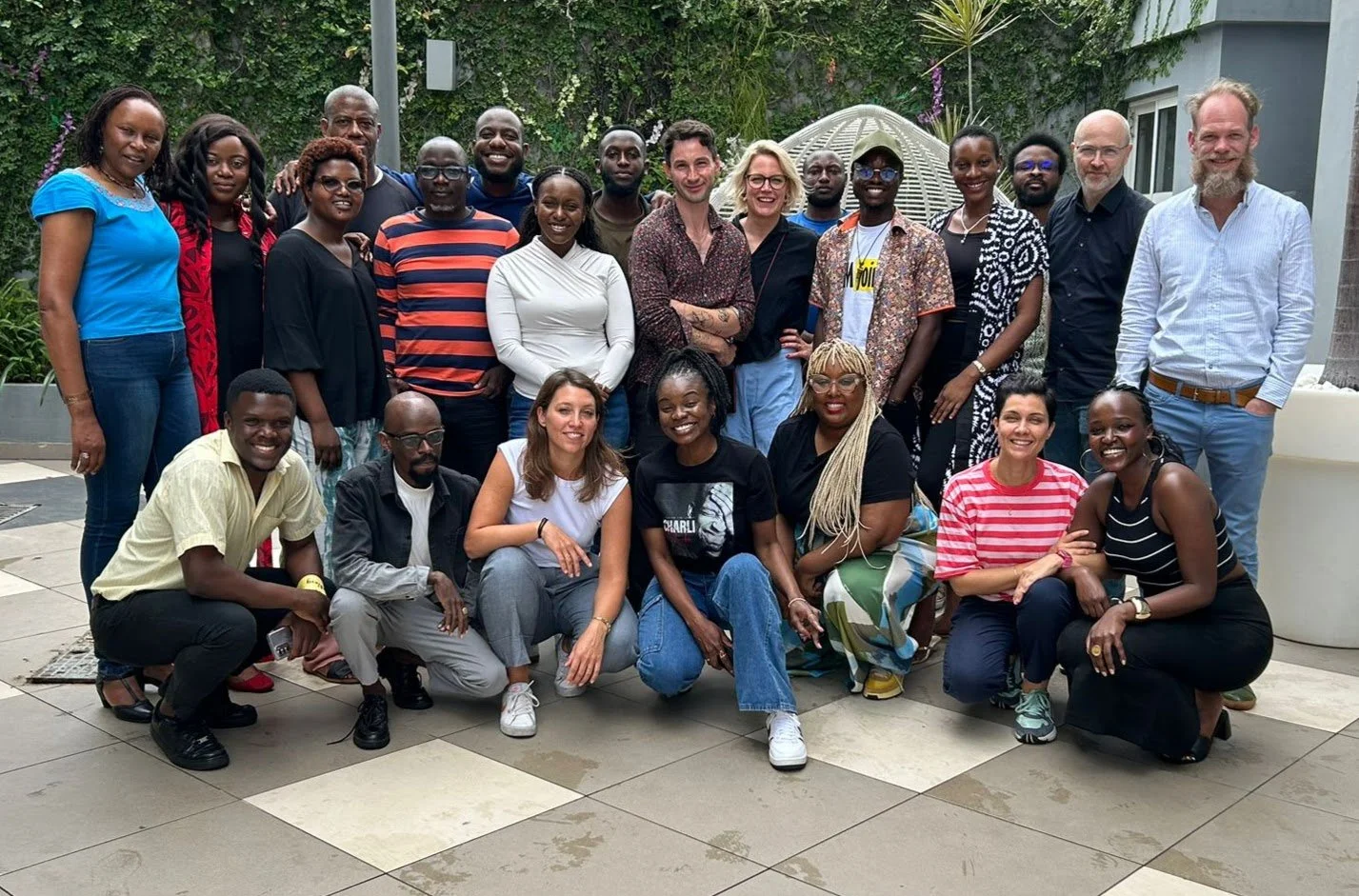
The Moving Picture Incubator group in Lagos, Nigeria — before Kigali, before the wave, before any of this made sense.
The rolling wave…
Kigali. End of day four. A group of film professionals from Rwanda, Nigeria, Kenya, and Germany, tired, buzzing, ready to go home. This was the second time we had come together. They were part of the Moving Picture Incubator, working on solving real film distribution roadblocks — with the ambition of launching new businesses together.
I asked if anyone had a closing ritual. One participant smiled, slapped his thighs, and started a rolling wave — the kind you see in football stadiums. Within seconds the whole room was in it, laughing, alive.
I've worked with teams in 30 countries. That moment was priceless.
Not because it was fun — though it was. But because of what it meant: a group of people who had started out as individuals, each carrying their own project and their own agenda, had become something else over the course of this program. They had become something — distinct teams, but a real community. And they knew it.
Nobody had planned that wave. But everything we had done together made it possible.
… did not happen by accident.
That moment didn't happen by accident. It was the result of something that most creative and gaming companies never deliberately build: the intentional processes that facilitate work, decisions, and human connection — infrastructure that matches the ambition of the work itself.
The incubator organisers — my clients — put it this way: the film distribution professionals had entered as strangers and left as teams — some even founding businesses together. What made that possible wasn't chemistry or luck. It was structure. A deliberate, well-designed and facilitated process.
Most studios and creative companies are extraordinarily good at one thing — the work. The film, the game, the product. What they rarely have is an equally sophisticated understanding of the human system producing that work.
The origins of my “magic sauce”
Where did that "magic sauce" come from? Certainly not from the gaming or film industry.
For nearly two decades I worked in one of the most methodologically advanced and rigorous organisational development environments I've ever encountered — international cooperation, operating across some of the world's most complex, high-stakes, multi-stakeholder contexts. Imagine facilitating strategic decisions between governments, NGOs, multinational industries, tech companies and local communities across 30 countries — all equally important, all pulling in different directions — where failure has real consequences for real people. You develop a certain muscle.
What I didn't fully appreciate until my first endeavours in the film industry was how transferable — and how badly needed — that muscle was in the creative world.
Because here's the thing about working under those conditions: you can't rely on authority, hierarchy, or compliance. You have to build the conditions for people to think, decide, and collaborate well. Every time. From scratch. That's what I'd been trained to do for many years — without even fully realising it.
The unglamorous reality of the creative industry
Sound familiar? Crunch that never ends. Burnout that gets normalised. Deadlines missed, then missed again. Conflicts that nobody names but everybody feels — often rooted in power imbalances that are never acknowledged, or roles so blurry that accountability quietly evaporates. And quietly, almost invisibly — your best people start looking for the exit.
But perhaps the most insidious symptom is one that's harder to measure: the slow disappearance of creative courage. When a human system is under sustained pressure, people stop taking risks. Ideas get smaller. Pitches get safer. The creative edge — the thing that made the work exciting in the first place — dulls almost imperceptibly.
Utopia is actually buildable
It doesn't have to be this way. And I don't mean that as a motivational poster.
I mean it literally: the conditions that produced that rolling wave in Kigali are buildable. Deliberately, systematically buildable — without sacrificing creative autonomy, without adding bureaucratic overhead, and without turning your studio into a corporation.
What does it actually look like? Roles that are clear enough to create accountability but flexible enough to honour creative reality. Decision-making processes that don't bottleneck at the top or dissolve into endless consensus. Conflict that gets named early, worked through properly, and actually makes the work better. Leadership that understands the difference between creative tension — which is generative — and organisational dysfunction — which is corrosive.
And underneath all of it: a human system that knows how to regulate itself under pressure. That can move fast without burning out. That can disagree without fracturing. That can take creative risks because people feel safe enough to fail.
That's not a utopia. That's just good organisational design.
The cost of the gap
And yet, for many people in the creative world I've spoken to, what I just described feels like a distant dream.
They didn't get into this for the burnout, the politics, or the conflict. They got into it for the work — the film, the game, the thing they love more than anything. And then reality arrived. The pressure. The dysfunction. The slow accumulation of everything nobody talks about.
Most of them don't leave because they want to. They leave because they can't take it anymore.
That gap — between what a creative company can be and what too many of them actually are — has a cost. In lost talent, lost creative courage, and lost potential. And it's bigger than most leaders realise. Usually, they only see it clearly when it's already too late.
So here's a question worth sitting with:
Imagine your dream hire seeing your company through a crystal ball — the real, everyday life, no filters. Would they want to join? And once inside — would they want to stay?
If any of this resonated — I'd love to hear what it brought up for you.