Remote Work Learnings From The 1990s Until Today
The very first remote work experience I remember was in 1999: I was 19 years old, we still paid the internet by the minute and modems screamed their infamous dial-up tones into the room. I sent the draft of a letter via email (sic!) to someone, 100 km away, for review. We discussed it on the (land line) phone while he was making edits to it on the PC. The way towards distributed teams was paved much earlier than we initially realised. And here is one of the many accounts to recount the story.
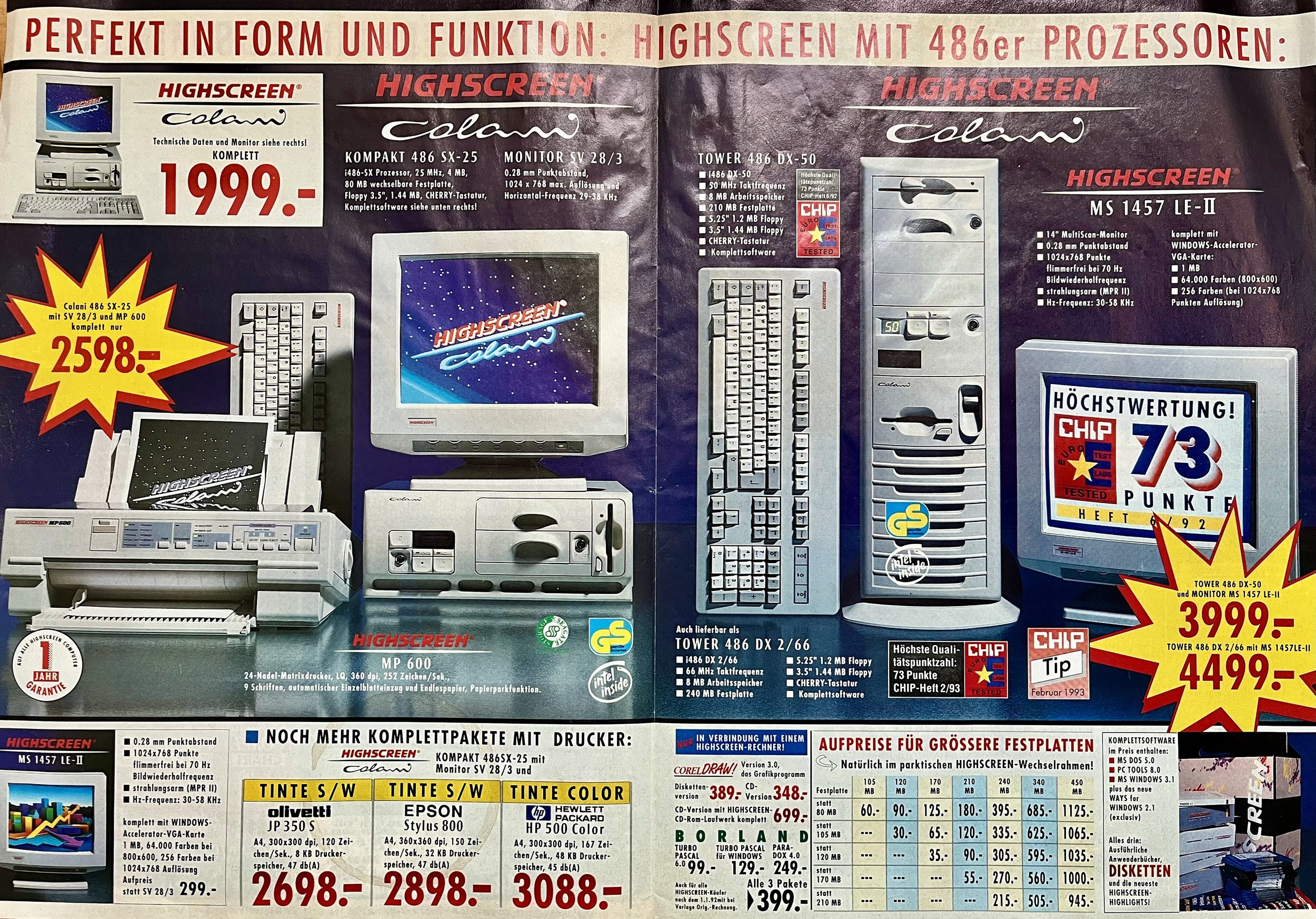
A sales brochure from 1993. A couple of things survived until today - like the x86 platform and Cherry keyboards ;)
The 90s’ Version Of A Distributed Team
I started working at the local administration in the City of Stralsund, Germany, in 1998 via internships during my studies. By 2001, I worked there full-time. We were several hundred employees, distributed in dozens of bigger and smaller offices all over the town. We were the 1990s version of a distributed team: You would need to walk or drive between 10 and 30 minutes to meet someone from a different department - but needed to collaborate with them all the time. So we picked up the phone.
And here’s the thing: I worked there for 6 years - and, despite being distributed, I can hardly remember any scheduled meetings. Give or take 80% of our collaborative work between individuals, units and departments, buildings and neighbourhoods was spontaneous: When you have an issue to resolve or need anything - call your colleagues or go and meet them when you’re nearby. Without scheduling an appointment. Emails? I have only written a couple of hundreds in 6 six entire years… That’s the daily inbox of some people today. Chat? Didn’t exist yet. So, phone calls and visits it was. And, since we were Germans, fax too, of course ;)
Relationship And Trust Building
When looking back, I realise we had a key success factor: We took a lot of time to build relationship and trust among each other. The result: Sometimes, we chatted for a while and would - effortless, almost as a side product - resolve the issue we met for in the first place. Or, we could very quickly talk on the telephone and come up with a result and next steps within minutes - instead of writing countless emails and carbon-copying a dozen people into it. Sure, we did write down things at one point. But in between there was always a sense of trust.
An Audio-Only Friendship
And here’s another remote work reference from around 2012. It’s actually not about work. It’s about connection - and a tool that took my remote experience to the next level. While living in Tunisia, I joined a gaming clan with its members distributed all over Germany. We gamed and talked with one another for over 2 years. One of the members became a really close friend of mine. What is absolute mind-blowing about it, is that we never, ever saw each other’s faces. I have no idea what he looks like and he does not know my face either. It was an audio-only experience. We hang out in “rooms” on TeamSpeak, a voice chat app that still exists today. The app delivers practically latency-free, crystal clear audio. It’s so good, that the NASA is among its customers.
When someone entered the app they would go into the rooms and quickly say hello to everyone. Sounds like a real office? That’s because it WAS just like in a real office. Wanted to talk to someone in private? You just told that person and went to the “room” (voice channel) next door together. Wanted to remain private? You locked the door behind you. Wanted to make an announcement to everyone? You just typed it and it appeared before everyone’s eyes. It was one of the most curious things I have experienced in my life.
In 2020, we did something really terrible
As someone, who has had these excellent, even inspiring remote work experiences over more than two decades, 2020 was a complete disaster: With everyone moving into the virtual space and (forced) distributed work from one day to the next, online work culture as I knew it, suddenly ceased to exist.
Out of nowhere, everyone scheduled a 30-minute meeting, 2 days ahead for something that could have been resolved in a spontaneous 2-minute phone call - or in the virtual hallway (see TeamSpeak).
As one of the results, everyone booked back-to-back meetings - 8 or 10 in a row. The entire day.
As a result, everyone showed up exactly the minute the meeting started (or later) and left the second the meeting was over. Small talk and unscheduled socialising died a sudden, silent death - after being around for thousands of years of human (meeting) history. How many pre-pandemic meetings can you remember going by without a minute or two of chatting with your peers just before, during or after the meeting?
People kept using their cameras all the time and got fatigued by the stress this creates (as an audio-first person, this was one of the greatest shock to me).
As a result, people did not engage during the meetings any more, some were in 2 meetings at the same time, others thought online interaction counted less and felt more like tourists visiting an attraction - and quickly disappearing without any commitment.
Online events got cancelled or delayed all the time. It was as if online commitment was worth less then its offline version.
I could not believe what I witnessed. Secretly, I was asking myself: where are all the online gamers using Discord and TeamSpeak? Where is the generation who grew up with these tools and this culture? Where are all the people who used to simply call others on their phones? And why on earth are the people at Zoom and MS-Teams not getting it?
But Not All Was Lost
The one thing I actually could salvage was how I worked with a close colleague of mine: For almost 3 years, we met - every single day - in a virtual office. On Discord. Discord is similar to TeamSpeak, but more user friendly. It worked. And it felt really good. Ironically, our collaboration slowly eroded over time, when we reduced and finally stopped seeing each other “at the office”. But while it lasted, it couldn’t have worked any better: It was everything I imagined it to be.
In the meantime, many remote-first teams are experimenting with - or right out betting on - virtual offices. Just a few weeks ago, I met a young remote worker from an international, distributed team. To my delight, she mentioned that they are using Discord - and how great this works for them. It put a smile on my face.
My favourite tool, today? Berst.io!
Of course, I am still using a virtual office. Once you see it work, you never want to go without it. The tool on which I have finally landed on is Berst.io. Full disclosure: I am a Berst brand ambassador. But not because I get paid for it (I don’t), but because I love their product and share their philosophy. And I trust the small Australian team behind it.
TeamSpeak is impressive, from a technical perspective. But when you try to bring a non-tech person onto the platform - well, good luck. It takes a lot of explaining.
Discord is both, technically thorough and user friendly. But you still need an account to operate, which limits its use case to the core team members. Plus, it has basically become a social media platform - which comes with all the inherent downsides and data security questions.
Berst.io has a lot of compelling arguments going for it. It’s browser-based and built on the open source Jitsi-standard. The company behind it is a small Australian start-up, not a US-based trillion-dollar tech overlord. Visitors / users don’t need an account. And most importantly: its creators put a lot of thoughts and effort into really helpful details - the kind you will not find on other platforms. I personally, use it as my virtual office, where people can visit and (co-)work with me. And as a place in which I run workshops and trainings with my clients.
The Big Learning
So what is the big learning or conclusion of this journey? What can we derive from this for remote work in the late 2020s?
Virtual rooms, that recreate a real-life, physical office are, in my experience, the single most important factor for truly engaging, trustful work as a high‑performing team. I am not saying, this is the only way. I know teams who have found a different approach to remote work. They are happy and get the work done. But I have also witnessed what a night-and-day difference a tool like Berst can deliver. How it transforms teams. I will gladly encourage you to give Berst – or any other tool in this category, for that matter – a try with your team.
If you want to see a real virtual office first hand - come visit me! Please bring a cup of coffee or tea, your questions and your curiosity.